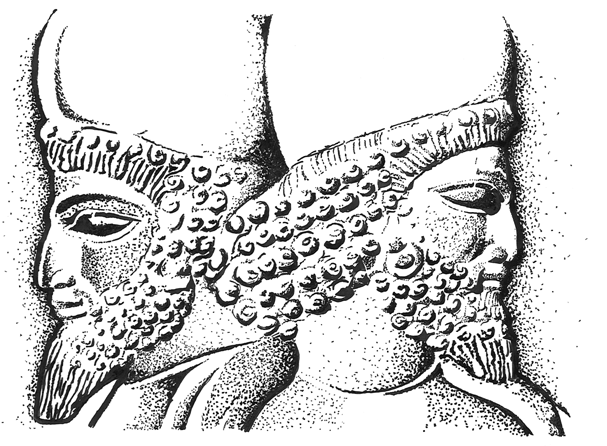
Two men who came to pay tribute to Darius (ca. 500 B.C.) from a bas-relief at Persepolis
Iran has been experiencing significant social changes since the 1979 Islamic Revolution that overthrew the monarchy. Ayatollah Sayyid Ruhollah Musavi Khomeini, the spiritual leader of the Revolution, and his supporters, who were organized in the Islamic Republican Party (IRP), were determined to desecularize Iranian society. They envisaged the destruction of the royal regime as a prelude to the creation of an Islamic society whose laws and values were derived from the Quran and religious texts sacred to Shia Islam. The flight into foreign exile of the royal family and most of the prerevolutionary political elite, and the imprisonment or cooptation of those who chose to remain, effectively enabled the Shia Islamic clergy to take over governmental institutions and to use the power and authority of the central government to implement programs designed to accomplish this goal. The creation of the Islamic Republic of Iran in 1979 resulted in the destruction of the power and influence of the predominantly secular and Western-oriented political elite that had ruled Iran since the early part of the twentieth century. The new political elite that emerged was composed of Shia clergymen and lay technocrats of middle-class origins. The major consequence of their programs has been cultural, that is, the desecularization of public life in Iran. By 1987 this new political elite had not adopted policies that would have caused any major restructuring of the country's economy. While there has been controversy regarding the appropriate role of the government in regulating the national economy, the overall philosophy of this new political elite has been that private property is respected and protected under Islam.
The establishment of an "ideal" religious society has been impeded by foreign war. Iran became involved in a protracted war with its neighbor, Iraq, in September 1980, when the latter country invaded Iran's oil-rich southwestern province of Khuzestan. This conflict has meant a total war for Iran. By 1987 at least 200,000 Iranians had been killed and another 350,000 to 500,000 wounded. At any one time, 600,000 men were under arms. Property destruction, including the complete leveling of one major city, several towns, and scores of villages, as well as extensive damage to industrial infrastructure and residential neighborhoods of other urban areas, was estimated at billions of dollars. The war also created the need to provide for as many as 1.5 million persons who had become refugees; to ration a wide variety of foodstuffs; to retool most major industries for the production of war-related goods; and to expend a substantial proportion of government resources, including revenues from the sale of petroleum, on the war effort.
Although the war with Iraq has imposed extraordinary burdens on the economy and society, the government of the Republic has continued its efforts to recast society according to religiously prescribed behavioral codes. These policies have resulted in a significant enhancement of the role that the mosque plays in society. The Shia clergy have become the major political actors not only at the national level but also at the local level, where the chief cleric in each town has assumed the functions of a de facto district governor. Thus, local mosques, in addition to fulfilling their traditional roles as places for prayer, have become primary sources of social services that formerly were obtained from various government ministries. Mosques also have become one of the principal institutions for enforcing the observance of public morals.
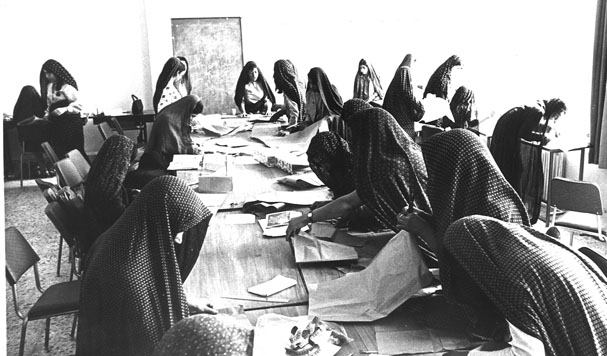
All the major cultural and social groups in Iran have been affected by the changes resulting from the establishment of the Republic. The secularized, Western-educated, upper and middle classes of the prerevolutionary period have been frequent targets of criticism by the clergy and lay political leaders, who have accused them of "immoral life- styles." These secular groups have tended to resent the laws that regulate individual behavior. In particular, they dislike hejab, the dress codes that require women to be covered in public except for their faces and hands, and the prohibition of all alcoholic beverages. Members of these classes, who predominated in the upper levels of the civil service and in the professions, have also been compelled to undergo "re-education classes" in Islam to retain their positions.
In contrast, the religious middle class, generally
identified as the bazaar class, has tended to support the laws the secularized
groups disliked because these laws reflect the ideal life-style that the
bazaar traditionally has tried to follow. Similarly, the lower classes
in both urban and rural areas have not necessarily tended to perceive laws
regulating behavior as intrusions because the religious sanctions have
for the most part merely reinforced the values of their generally conservative
life-styles.
Iran is one of the world's most mountainous countries. Its mountains have helped to shape both the political and the economic history of the country for several centuries. The mountains enclose several broad basins, or plateaus, on which major agricultural and urban settlements are located. Until the twentieth century, when major highways and railroads were constructed through the mountains to connect the population centers, these basins tended to be relatively isolated from one another. Typically, one major town dominated each basin, and there were complex economic relationships between the town and the hundreds of villages that surrounded it. In the higher elevations of the mountains rimming the basins, tribally organized groups practiced transhumance, moving with their herds of sheep and goats between traditionally established summer and winter pastures. There are no major river systems in the country, and historically transportation was by means of caravans that followed routes traversing gaps and passes in the mountains. The mountains also impeded easy access to the Persian Gulf and the Caspian Sea.
With an area of 1,648,000 square kilometers, Iran ranks sixteenth in size among the countries of the world. Iran is about one-fifth the size of the continental United States, or slightly larger than the combined area of the contiguous states of California, Arizona, Nevada, Oregon, Washington, and Idaho.
Located in southwestern Asia, Iran shares its entire northern border
with the Soviet Union. This border extends for more then 2,000 kilometers,
including nearly 650 kilometers of water along the southern shore of the
Caspian Sea. Iran's western borders are with Turkey in the north and Iraq
in the south, terminating at the Shatt al Arab (which Iranians call the
Arvand Rud). The Persian Gulf and Gulf of Oman littorals form the entire
1,770-kilometer southern border. To the east lie Afghanistan on the north
and Pakistan on the south. Iran's diagonal distance from Azarbaijan in
the northwest to Baluchestan va Sistan in the southeast is approximately
2,333 kilometers.
Topography
Iran consists of rugged, mountainous rims surrounding high interior basins. The main mountain chain is the Zagros Mountains, a series of parallel ridges interspersed with plains that bisect the country from northwest to southeast. Many peaks in the Zagros exceed 3,000 meters above sea level, and in the south-central region of the country there are at least five peaks that are over 4,000 meters. As the Zagros continue into southeastern Iran, the average elevation of the peaks declines dramatically to under 1,500 meters. Rimming the Caspian Sea littoral is another chain of mountains, the narrow but high Alborz Mountains. Volcanic Mount Damavand (5,600 meters), located in the center of the Alborz, is not only the country's highest peak but also the highest mountain on the Eurasian landmass west of the Hindu Kush.
The center of Iran consists of several closed basins that collectively are referred to as the Central Plateau. The average elevation of this plateau is about 900 meters, but several of the mountains that tower over the plateau exceed 3,000 meters. The eastern part of the plateau is covered by two salt deserts, the Dasht-e Kavir and the Dasht-e Lut. Except for some scattered oases, these deserts are uninhabited.
Iran has only two expanses of lowlands: the Khuzestan plain in the southwest and the Caspian Sea coastal plain in the north. The former is a roughly triangular-shaped extension of the Mesopotamia plain and averages about 160 kilometers in width. It extends for about 120 kilometers inland, barely rising a few meters above sea level, then meets abruptly with the first foothills of the Zagros. Much of the Khuzestan plain is covered with marshes. The Caspian plain is both longer and narrower. It extends for some 640 kilometers along the Caspian shore, but its widest point is less than 50 kilometers, while at some places less than 2 kilometers separate the shore from the Alborz foothills. The Persian Gulf coast south of Khuzestan and the Gulf of Oman coast have no real plains because the Zagros in these areas come right down to the shore.
There are no major rivers in the country. Of the small rivers and streams,
the only one that is navigable is the Karun, which shallow- draft boats
can negotiate from Khorramshahr to Ahvaz, a distance of about 180 kilometers.
Several other permanent rivers and streams also drain into the Persian
Gulf, while a number of small rivers that originate in the northwestern
Zagros or Alborz drain into the Caspian Sea. On the Central Plateau, numerous
rivers, most of which have dry beds for the greater part of the year, form
from snow melting in the mountains during the spring and flow through permanent
channels, draining eventually into salt lakes that also tend to dry up
during the summer months. There is a permanent salt lake, Lake Urmia (the
traditional name, also cited as Lake Urmiyeh, to which it has reverted
after being called Lake Rezaiyeh under Mohammad Reza Shah), in the northwest,
whose brine content is too high to support fish or most other forms of
aquatic life. There are also several connected salt lakes along the Iran-Afghanistan
border in the province of Baluchestan va Sistan.
Climate
Iran has a variable climate. In the northwest, winters are cold with heavy snowfall and subfreezing temperatures during December and January. Spring and fall are relatively mild, while summers are dry and hot. In the south, winters are mild and the summers are very hot, having average daily temperatures in July exceeding 38° C. On the Khuzestan plain, summer heat is accompanied by high humidity.
In general, Iran has an arid climate in which most of the relatively
scant annual precipitation falls from October through April. In most of
the country, yearly precipitation averages 25 centimeters or less. The
major exceptions are the higher mountain valleys of the Zagros and the
Caspian coastal plain, where precipitation averages at least 50 centimeters
annually. In the western part of the Caspian, rainfall exceeds 100 centimeters
annually and is distributed relatively evenly throughout the year. This
contrasts with some basins of the Central Plateau that receive ten centimeters
or less of precipitation annually.
In November 1986, the government reported that the preliminary count in the fourth national census, which had been conducted during October, showed a total population of 48,181,463. According to the government, this total included about 2.6 million refugees who had come from Afghanistan and Iraq since 1980. The population of Iranian nationals, approximately 45.6 million, represented an increase of about 12 million over the 33.7 million enumerated in the 1976 census. This indicated that the >Iranian population had grown at an annual rate of 3.6 percent between 1976 and 1986. A population increase in excess of 3.3 percent per year puts Iran's population growth rate among the higher rates in the world.
The preliminary report on the 1986 census showed that Iran's population had been growing at a faster rate since 1976 than during earlier periods. Throughout the first half of the twentieth century, estimates and scattered population surveys indicated that the average population growth rate was less than 2 percent annually. After World War II, however, the population growth rate began to rise. Between the first national census in 1956, when Iran's population numbered 19 million, and the second national census in 1966, when the population count was 25.3 million, the annual growth rate averaged 2.9 percent. The results of the 1976 national census, however, indicated a slight decrease in the average annual growth rate to 2.7 percent.
The sharp increase in the population growth rate from 2.7 percent to nearly 3.6 percent per year between 1976 and 1986 appeared to be related to the Revolution in 1979. Prior to the Revolution, the government had promoted a family planning program; however, following the Revolution, the new government ceased all official involvement in family planning. Although there has been no religious prohibition on birth control, government pronouncements and literature have tended to extol the virtues of large families.
In mid-1987, data on vital statistics from the 1986 preliminary census were incomplete, but some demographic changes were already evident. The 1976 census data had indicated that 51.4 percent of the population was male and 48.6 was female. The median age of the population was 16.5 years, and less than 3.5 percent of the population was over 65. The relatively large population increase between 1976 and 1986 had the effect of increasing the already extreme youthfulness of the population. In 1986 the government announced that 50 percent of the population was under 15 years of age, and about 45 percent was in the 15- to 59-year age group, while only 5 percent was over the age of 60.
According to the preliminary results of the 1986 census, the average
population density for the country was twenty-nine persons per square kilometer.
In some regions, especially along the Caspian coast and in East Azarbaijan,
the average density was significantly higher, while in the more arid regions
of the Central Plateau and Baluchestan va Sistan, average population density
was ten or fewer persons per square kilometer.
Major Cities
Tehran, the capital, is the country's largest city and the second most populous city in the Middle East after Cairo. Tehran is a comparatively young city, the origins of which date back about 700 years. The old part of the city is a few kilometers to the northwest of ancient Rey, an important city that was destroyed by the Mongol invasions of the thirteenth century. Tehran was founded by refugees from Rey, but remained an insignificant small town until the end of the eighteenth century, when the founder of the Qajar dynasty chose it to be his capital. Tehran has been the capital of the country ever since.
The centralization of the government and the expansion of the bureaucracy under the Pahlavis, the last royal dynasty, were major factors in Tehran's rapid growth after 1925. The city's population doubled between 1926 and 1940 and tripled between 1940 and 1956, when it reached more than 1.5 million. Tehran's population continued to grow rapidly, exceeding 2.7 million by 1966. Its population in the 1986 census was slightly over 6 million. This figure represented a 35 percent increase over the 1976 census of slightly under 4.5 million.
In 1986 Iran had one other city, Mashhad, with a population over 1 million. Mashhad's population of more than 1.4 million represented an increase of 110 percent since 1976. Much of its growth was attributed to the large number of Afghan refugees, approximately 450,000, who were living in the city. The historical origins of Mashhad are similar to those of Tehran inasmuch as the city essentially developed after the centuries- old city of Tus, near modern Mashhad, was destroyed by the Mongols. Mashhad has served as the principal commercial center of Khorasan since the nineteenth century, although its major growth has occurred only since the mid-1950s. It also has become an important manufacturing center and has numerous carpet, textile, and food-processing factories.
Iran's other major cities include Esfahan, Tabriz, and Shiraz, all of
which had populations of 800,000 or more in 1986. Like Mashhad, these cities
have experienced relatively rapid growth since the mid-1950s. All three
of these cities are important manufacturing centers, especially Esfahan,
where many of Iran's heavy industries are concentrated. Smaller cities
(populations of 100,000 to 500,000) such as Ahvaz, Bakhtaran (before the
Revolution Kermanshah), Hamadan, Karaj, Kerman, Qazvin, Qom, Rasht, and
Urumiyeh (or Urmia, formerly known as Rezaiyeh) also have grown considerably
since 1956. A total of 30 cities, more than double the number in the 1966
census, had populations exceeding 100,000 in 1986.
Emigration
Since the Revolution, there has been a small but steady emigration of educated Iranians. Estimates of the number vary from 750,000 to 1.5 million. Most such emigrants have preferred to settle in Western Europe or the United States, although there are also sizable communities of Iranians in Turkey. Newspapers in Istanbul claimed during 1986 that as many as 600,000 Iranians were living in Turkey, although the Turkish Ministry of Interior has reported that there are only about 30,000 Iranians in the country. The United States census for 1980 found 122,000 Iranians living in the United States. By 1987 it was estimated this number exceeded 200,000, with the largest concentration found in southern California.
Iranian emigrants tended to be highly educated, many holding degrees from American and West European universities. A sizable proportion were members of the prerevolutionary political elite. They had been wealthy before the Revolution, and many succeeded in transferring much of their wealth out of Iran during and after the Revolution.
Other Iranians who have emigrated include members of religious minorities,
especially Bahais and Jews; intellectuals who had opposed the old regime,
which they accused of suppressing free thought and who have the same attitude
toward the Islamic Republic; members of ethnic minorities; political opponents
of the government in Tehran; and some young men who deserted from the military
or sought to avoid conscription. There were virtually no economic emigrants
from Iran, although a few thousand Iranians have continued to work in Kuwait,
Qatar, and other Persian Gulf states, as before the Revolution.
Refugees
The preliminary 1986 national census figures included approximately 2.6 million persons listed as refugees of foreign nationality. The largest number, consisting of slightly more than 2.3 million, were Afghans. The refugees from Afghanistan were concentrated in several refugee camps in eastern Iran, but approximately one-third of them were living in such cities as Mashhad, Shiraz, and Tehran at the time of the census. In addition, there were nearly 300,000 refugees from Iraq, with which Iran had been at war since 1980.
The influx of foreign refugees was the direct result of war on Iran's borders. Since early 1980, the Afghan refugees had been fleeing the fighting in their country between various Afghan resistance groups and government forces assisted by more than 100,000 Soviet troops. The Iraqi refugees were expelled by their own government, which claimed that they were really Iranian descendants of persons who had immigrated to Iraq from Iran many years ago. In addition to refugees of foreign origins, Tehran has had to cope with several hundred thousand Iranian civilian refugees from the war zones.
The Iraqi advance into Khuzestan in the fall of 1980 resulted in extensive damage to the residential areas of two of Iran's major cities, Abadan and Khorramshahr, as well as the destruction of numerous small towns and villages. The intensive shelling of the large cities of Ahvaz and Dezful also destroyed residential neighborhoods. Consequently, tens of thousands of civilians fled southwestern Iran in 1980 and 1981, and the government set up refugee reception areas in Shiraz, Tehran, and other cities removed from the battle zone. During the Iraqi occupation of Khuzestan, the government had to shelter up to 1.5 million refugees. Efforts to resettle at least some of the refugees were undertaken in 1983 after Iran had recaptured much of Khuzestan from Iraq; however, continued fighting in the area and Iraqi air strikes on cities and towns in western Iran resulted in a steady stream of displaced civilians in need of food and shelter.
During the period 1980 to 1981, the government of Iraq expelled into Iran about 200,000 persons whom it claimed were Iranians. Most were Iraqi citizens, sometimes whole families, who were or had been residents of Iraq's Shia shrine cities and also were descendants of Iranian clergy and pilgrims who had settled in the religious centers as far back as the eighteenth century. In most cases, the refugees had never been to Iran and could speak no Persian (Farsi). Furthermore, they were required to leave the greater part of their possessions in Iraq. Thus, the Iranian government had to provide them with basic food and shelter.
Developing policies to deal with the Afghan refugees became a major burden for the government as early as 1984 because the number of Afghan refugees had continued to increase almost daily since the first group crossed the border in 1980. Iran, however, received virtually no international assistance for the Afghan refugees. It set up several camps in eastern Iran where the refugees were processed and provided with basic shelter and rations. These camps were located in or near towns in Khorasan and were provided with certain municipal services such as free access to public schools for registered refugee children. Although no data have been published on the gender and age composition of the refugees, press reports indicate that most were probably women, children, and men too old to fight, as in the Afghan refugee camps in Pakistan. Most of the young men probably remained with the Afghan resistance forces for the greater part of the year.
Although the Afghans were required to live in the special refugee camps,
by 1986 an estimated one-third of them had left the camps and were living
in residential areas of large cities such as Mashhad, Shiraz, and Tehran.
The Afghans apparently came to the cities in order to earn money to support
families who remained in the camps. They engaged in street vending and
worked on construction sites or in factories. The Iranian press periodically
reported on the roundup of such Afghans and their forcible return to the
camps. The Afghans needed special work permits, but it was not clear whether
these were difficult or easy to obtain or whether private employers required
them as a condition of employment.
Iran has a heterogeneous population speaking a variety of Indo-Iranian, Semitic, and Turkic languages. The largest language group consists of the
speakers of Indo-Iranian languages, who in 1986 comprised about 70 percent
of the population. The speakers of Indo-Iranian languages are not, however,
a homogeneous group. They include speakers of Persian, the official language
of the country, and its various dialects; speakers of Kirmanji, the term
for related dialects spoken by the Kurds who live in the cities, towns,
and villages of western Iran and adjacent areas of Iraq and Turkey; speakers
of Luri, the language of the Bakhtiaris and Lurs who live in the Zagros;
and Baluchi, the language of the seminomadic people who live in southeastern
Iran and adjacent areas of Afghanistan and Pakistan. Approximately 28 percent
of the population speaks various dialects of Turkish. Speakers of Semitic
languages include Arabs and Assyrians.
The Persian Language
The official language of Iran is Persian (the Persian term for which is Farsi). It is the language of government and public instruction and is the mother tongue of half of the population. Persian is spoken as a second language by a large proportion of the rest. Many different dialects of Persian are spoken in various parts of the Central Plateau, and people from each city can usually be identified by their speech. Some dialects, such as Gilaki and Mazandari, are distinct enough to be virtually unintelligible to a Persian speaker from Tehran or Shiraz.
Persian is an ancient language that has developed through three historical stages. Old Persian dates back to at least 514 B.C. and was used until about A.D. 250. It was written in cuneiform and used exclusively for royal proclamations and announcements. Middle Persian, also known as Pahlavi, was in use from about A.D. 250 to 900. It was the official language of the Sassanid Empire and of the Zoroastrian priesthood. It was written in an ideographic script called Huzvaresh.
Modern Persian is a continually evolving language that began to develop about A.D. 900. Following the Arab conquest of the Sassanid Empire in the seventh century and the gradual conversion of the population to Islam, Arabic became the official, literary, and written language, but Persian remained the language of court records. Persian, however, borrowed heavily from Arabic to enrich its own vocabulary and eventually adopted the Arabic script. In subsequent centuries, many Turkic words also were incorporated into Persian.
As part of the Indo-European family of languages, Persian is distantly related to Latin, Greek, the Slavic and Teutonic languages, and English. This relationship can be seen in such cognates as beradar (brother), pedar (father), and mader (mother). It is a relatively easy language for English-speaking people to learn compared with any other major language of the Middle East. Verbs tend to be regular, nouns lack gender and case distinction, prepositions are much used, noun plural formation tends to be regular, and word order is important. The difficulty of the language lies in the subtlety and variety of word meanings according to context. Persian is written right to left in the Arabic script with several modifications. It has four more consonants than Arabic -- pe, che, zhe, and gaf -- making a total of thirty-two letters. Most of the letters have four forms in writing, depending on whether they occur at the beginning, in the middle, or at the end of a word or whether they stand separately. The letters stand for the consonants and the three long vowels; special marks written above or below the line are used to denote short vowels. These signs are used only in dictionaries and textbooks, so that a reader must have a substantial vocabulary to understand a newspaper, an average book, or handwriting.
Persian is the most important of a group of several related languages that linguists classify as Indo-Iranian. Persian speakers regard their language as extremely beautiful, and they take great pleasure in listening to the verses of medieval poets such as Ferdowsi, Hafez, and Sadi. The language is a living link with the past and has been important in binding the nation together.
There is no accepted standard transliteration of Persian into Latin letters, and Iranians write their names for Western use in a variety of ways, often following French spelling. Among scholars and librarians a profound dispute exists between those who think Persian should be transliterated in conformity with the rules for Arabic and those who insist that Persian should have its own rules because it does not use all of the same sounds as Arabic.
Among educated Persians, there have been sporadic efforts as far back
as the tenth century to diminish the use of Arabic loanwords in their language.
Both Pahlavi shahs supported such efforts in the twentieth century. During
the reign of Reza Shah Pahlavi (1925-41), serious consideration was given
to the possibility of Romanizing the writing of Persian as had been done
with Turkish, but these plans were abandoned. Since the Revolution, a contrary
tendency to increase the use of Arabic words in both spoken and written
Persian has emerged among government leaders.
The Persian-speaking People
The Persians constitute the largest ethnic component in Iran. They predominate in the major urban areas of central and eastern Iran -- in the cities of Tehran, Esfahan, Mashhad, Shiraz, Arak, Kashan, Kerman, Qom, and Yazd -- and in the villages of the Central Plateau. An estimated 50 to 60 percent of the population speaks Persian as a first language.
In music, poetry, and art the Persians consider themselves -- and are generally considered by other groups -- as the leaders of the country. This feeling is strengthened by a consciousness of a heroic past and a rich literary heritage. Both before the Revolution and since, Persians have filled the majority of government positions.
The vast majority of Persians are Shia Muslims. The Shia religion serves
as a source of unity among Persians and other Iranian Shias. Since at least
the beginning of the nineteenth century, Persians have dominated the higher
ranks of the Shia clergy and have provided important clerical revolutionary
leaders such as ayatollahs Khomeini and Hosain Ali Montazeri. Fewer than
500,000 Persians are followers of other faiths. These include Bahais, Jews,
or members of the pre-Islamic Zoroastrian faith.
Iranian speaking Groups
Lurs and Bakhtiaris
In the central and southern Zagros live the Bakhtiaris and the Lurs, two groups that speak Luri, a language closely related to Persian. Linguists have identified two Luri dialects: Lur Buzurg, which is spoken by the Bakhtiari, Kuhgiluyeh, and Mamasani tribes; and Lur Kuchik, which is spoken by the Lurs of Lorestan. Like the Persians, the Bakhtiaris and Lurs are Shia Muslims. Historically, each of the two groups was organized into several tribes. The tribal leaders or khans, especially those of the Bakhtiari tribes, were involved in national politics and were considered part of the prerevolutionary elite.
The Bakhtiaris have been considered both a political and a tribal entity separate from other Lurs for at least two centuries. They are concentrated in an area extending southward from Lorestan Province to Khuzestan Province and westward from Esfahan to within eighty kilometers of the present-day Iraqi border. A pastoral nomadic tribe called Bakhtiari can be traced back in Iranian history to as early as the fourteenth century, but the important Bakhtiari tribal confederation dates only from the nineteenth century. At the height of Bakhtiari influence, roughly from 1870 to 1930, the term Bakhtiari came to be associated not just with the nomadic tribes that provided the military prowess of the confederation but also with the villagers and even town dwellers who were under Bakhtiari jurisdiction. Thus, some Arabic-, Persian-, and Turkic-speaking peasants were considered part of the Bakhtiari. Beginning in the 1920s, the Pahlavi shahs gradually succeeded in establishing the authority of the central government in the Bakhtiari area. Several campaigns also were undertaken to settle forcibly the nomadic pastoral component of the Bakhtiari. The combined political and economic pressures resulted in a significant decline in the power of the Bakhtiari confederation. Detribalized Bakhtiaris, especially those who settled in urban areas and received an education in state schools, tended to be assimilated into Persian culture. By the time of the Revolution in 1979 the term Bakhtiari tended to be restricted to an estimated 250,000 tribespeople, most of whom still practiced pastoral nomadism.
Historically, the Bakhtiaris have been divided into two main tribal groups. The Chahar Lang are located in the northwest of the Bakhtiari country and until the middle of the nineteenth century retained the leadership of all the Bakhtiari tribes. The Haft Lang, the southwestern group, have been more closely associated with modern Iranian politics than the Chahar Lang and in some instances have exercised significant influence.
The Lurs (closely related to the Bakhtiaris) live in the Zagros to the
northwest, west, and southeast of the Bakhtiaris. There were about 500,000
Lurs in Iran in the mid-1980s. The Lurs are divided into two main groups,
the Posht-e Kuhi and the Pish-e Kuhi. These two groups are subdivided into
more than sixty tribes, the most important of which include the Boir Ahmadi,
the Kuhgiluyeh, and the Mamasani. Historically, the Lurs have included
an urban segment based in the town of Khorramabad, the provincial capital
of Lorestan. Prior to 1900, however, the majority of Lurs were pastoral
nomads. Traditionally, they were considered among the fiercest of Iranian tribes and had acquired an unsavory reputation on account of their habit
of preying on both Lur and non-Lur villages. During the 1920s and 1930s,
the government of Reza Shah undertook several coercive campaigns to settle
the nomadic Lurs. Following the abdication of Reza Shah in 1941, many of
the recently settled tribes reverted to nomadism. Mohammad Reza Shah Pahlavi's
government attempted with some success through various economic development
programs to encourage the remaining nomadic Lurs to settle. By 1986 a majority
of all Lurs were settled in villages and small towns in the traditional
Lur areas or had migrated to cities.
Baluchis
The Baluchis -- who constitute the majority of the population in Baluchestan va Sistan -- numbered approximately 600,000 in Iran in the mid-1980s. They are part of a larger group that forms the majority of the population of Baluchistan Province in Pakistan and of some areas in southern Afghanistan. In Iran the Baluchis are concentrated in the Makran highlands, an area that stretches eastward along the Gulf of Oman coast to the Pakistan border and includes some of the most desolate country in the world. The Baluchis speak an Indo-Iranian language that is distantly related to Persian and more closely related to Pashtu, one of the major languages of Afghanistan and Pakistan. Historically, Baluchi has been only an oral language, although educated Baluchis in Pakistan have developed a written script that employs the Arabic alphabet. Unlike the majority of Persians, the majority of Baluchis are Sunni rather than Shia Muslims. This religious difference has been a source of tension in the past, especially in the ethnically mixed provincial capital of Zahedan. Religious tensions have been exacerbated since the establishment of the Republic.
About half of the Baluchis are seminomadic or nomadic; the remainder
are settled farmers or townsmen. Tribal organization remains intact among
nomadic and seminomadic Baluchis; tribal patterns of authority and obligation
have also been retained by the majority of settled Baluchis. The Baluchis
have been one of the most difficult tribal groups for the central government
to control, in large part because of poor communications between Tehran
and Baluchestan va Sistan. With the exception of the city of Zahedan, neither
the monarchy nor the Republic invested any significant funds in local development
projects. As a result, the Baluchis are one of the poorest and least educated
peoples in Iran. Most of the principal Baluchi tribes in Iran border Pakistan
or Afghanistan. They include the Yarahmadzai, the Nauri, the Gomshadzai,
the Saravan, the Lashari, and the Barazani. Along the coast of the Gulf
of Oman live the important tribes of Sadozai and Taherza.
Kurds
The Kurds speak a variety of closely related dialects, which in Iran are collectively called Kirmanji. The dialects are divided into northern and southern groups, and it is not uncommon for the Kurds living in adjoining mountain valleys to speak different dialects. There is a small body of Kurdish literature written in a modified Arabic script. Kurdish is more closely related to Persian than is Baluchi and also contains numerous Persian loanwords. In large Kurdish cities, the educated population speaks both Persian and Kurdish.
There are approximately 4 million Kurds in Iran. They are the third most important ethnic group in the country after the Persians and Azarbaijanis and account for about 9 percent of the total population. They are concentrated in the Zagros Mountain area along the western frontiers with Turkey and Iraq and adjacent to the Kurdish populations of both those countries. Kurds also live in the Soviet Union and Syria. The Kurdish area of Iran includes most of West Azarbaijan, all of Kordestan, much of Bakhtaran (formerly known as Kermanshahan) and Ilam, and parts of Lorestan. Historically, the Kurds of Iran have been both urban and rural, with as much as half the rural population practicing pastoral nomadism in different periods of history. By the mid-1970s, fewer than 15 percent of all Kurds were nomadic. In addition, during the 1970s there was substantial migration of rural Kurds to such historic Kurdish cities as Bakhtaran (known as Kermanshah until 1979), Sanandaj, and Mahabad, as well as to larger towns such as Baneh, Bijar, Ilam, Islamabad (known as Shahabad until 1979), Saqqez, Sar-e Pol-e Zahab, and Sonqor. Educated Kurds also migrated to non-Kurdish cities such as Karaj, Tabriz, and Tehran.
There are also scatterings of Kurds in the provinces of Fars, Kerman, and Baluchestan va Sistan, and there is a large group of approximately 350,000 living in a small area of northern Khorasan. These are all descendants of Kurds whom the government forcibly removed from western Iran during the seventeenth century.
Most of the rural Kurds retain a tribal form of social organization, although the position of the chief is less significant among the majority of Kurds who live in villages than it is among the unsettled pastoralists. An estimated forty Kurdish tribes and confederations of tribes were still recognized in the mid-1980s. Many of these were organized in the traditional manner, which obligated several subordinate clans to pay dues in cash or produce and provide allegiance to a chief clan. The land reform program of the 1960s did not disrupt this essentially feudal system among most tribally organized Kurds.
The majority of both rural and urban Kurds in West Azarbaijan and Kordestan practice Sunni Islam. There is more diversity of religious practice in southern Kurdish areas, especially in the Bakhtaran area, where many villagers and townspeople follow Shia beliefs. Schismatic Islamic groups, such as the Ahl-e Haqq and the Yazdis, both of which are considered heretical by orthodox Shias, traditionally have had numerous adherents among the Kurds of the Bakhtaran region. A tiny minority of Kurds are adherents of Judaism.
The Kurds have manifested an independent spirit throughout modern Iranian history, rebelling against central government efforts to restrict their
autonomy during the Safavid, Qajar, and Pahlavi periods. The most recent
Kurdish uprising took place in 1979 following the Revolution. Mahabad,
which has been a center of Kurdish resistance against Persian authority
since the time of the Safavid monarch Shah Abbas (1587-1629), was again
at the forefront of the Kurdish autonomy struggle. Intense fighting between
government forces and Kurdish guerrillas occurred from 1979 to 1982, but
since 1983 the government has asserted its control over most of the Kurdish
area.
Other Groups
Scattered throughout central, southern, and eastern Iran are small groups
speaking many different Indo-Iranian languages. In the southern part of
the Central Plateau are such small nomadic and seminomadic tribes. Other
tribes, related to groups in neighboring Afghanistan and the Soviet Union,
are found in Khorasan. Also in Khorasan are an estimated 25,000 Tajiks,
a settled farming people related to the Tajiks of Afghanistan and the Soviet
Union. Distinguishable, but comparatively smaller, Indo-Iranian-speaking minorities are the following tribally organized settled groups: the Hazareh,
Barbai, Teimuri, Jamshidi, and Afghani in Khorasan; the Qadikolahi and
Palavi in Mazandaran; and the Sasani and Agajani in the Talesh region of
Gilan.
Turkic-speaking Groups
The second major element of the population is composed of various Turkic-speaking groups. The Turkic languages belong to the Ural-Altaic family, which includes many languages of Soviet Central Asia and western China, as well as Turkish, Hungarian, and Finnish. The various Turkic languages spoken in Iran tend to be mutually intelligible. Of these, only Azarbaijani is written to any extent. In Iran it is written in the Arabic script, in contrast to the Azarbaijani in Turkey, which is written in the Roman script, and that of the Soviet Union, which is written in the Cyrillic script. Unlike Indo-European languages, Turkic languages are characterized by short base words to which are added numerous prefixes and suffixes, each addition changing the meaning of the base. They are also distinguished by their vowel harmony, which means that the kind of vowel used in the base word and the additives must agree. Thus, lengthy words might be filled with "o's" and "u's" or with "a's" and "e's," but not with mixtures of the two.
Turkic speakers make up as much as 25 percent of Iran's total population.
They are concentrated in northwestern Iran, where they form the overwhelming
majority of the population of East Azarbaijan and a majority of West Azarbaijan.
They also constitute a significant minority in the provinces of Fars, Gilan,
Hamadan, Khorasan, Mazandaran, and Tehran. Except for the Azarbaijanis,
most of the Turkic groups are tribally organized. Some of the Turkic tribes
continue to follow a nomadic or seminomadic life. Educated Turkic speakers
in the large cities speak and understand Persian.
Azarbaijanis
By far the largest Turkic-speaking group are the Azarbaijanis, who account
for over 85 percent of all Turkic speakers in Iran. Most of the Azarbaijanis
are concentrated in the northwestern corner of the country, where they
form the majority population in an area between the Caspian Sea and Lake
Urmia and from the Soviet border south to the latitude of Tehran. Their
language, Azarbaijani (also called Azeri or Turkish), is structurally similar
to the Turkish spoken in Turkey but with a strikingly different accent.
About half of all Azarbaijanis are urban. Major Azarbaijani cities include
Tabriz, Urmia, Ardabil, Zanjan, Khoy, and Maragheh. In addition, an estimated
one-third of the population of Tehran is Azarbaijani and there are sizable
Azarbaijani minorities in other major cities, such as Hamadan, Karaj, and
Qazvin. The life styles of urban Azarbaijanis do not differ from those
of Persians, and there is considerable intermarriage among the upper classes
in cities of mixed populations. Similarly, customs among Azarbaijani villagers
do not appear to differ markedly from those of Persian villagers. The majority
of Azarbaijanis, like the majority of Persians, are Shia Muslims. A tiny
minority of Azarbaijanis are Bahais.
Qashqais
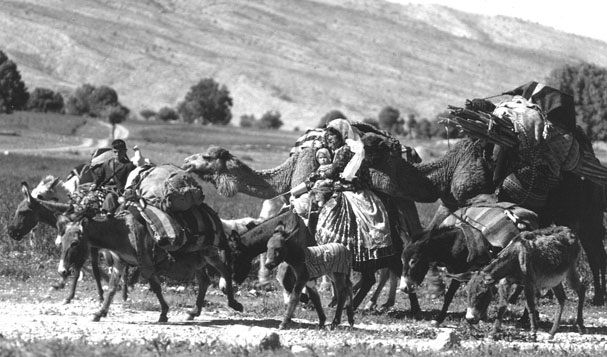
A nomadic Qashqai family moving to new grazing
ground The Qashqais are the second largest Turkic group in Iran. The Qashqais
are a confederation of several Turkic-speaking tribes in Fars Province
numbering about 250,000 people. They are pastoral nomads who move with
their herds of sheep and goats between summer pastures in the higher elevations
of the Zagros south of Shiraz and winter pastures at low elevations north
of Shiraz. Their migration routes are considered to be among the longest
and most difficult of all of Iran's pastoral tribes. The majority of Qashqais
are Shias.
The Qashqai confederation emerged in the eighteenth century when Shiraz
was the capital of the Zand dynasty. During the nineteenth century, the
Qashqai confederation became one of the best organized and most powerful
tribal confederations in Iran, including among its clients hundreds of
villages and some non-Turkic-speaking tribes. Under the Qashqais' most
notable leader, Khan Solat ad Doleh, their strength was great enough to
defeat the British-led South Persia Rifles in 1918. Reza Shah's campaigns
against them in the early 1930s were successful because the narrow pass
on the route from their summer to winter pastures was blocked, and the
tribe was starved into submission. Solat and his son were imprisoned in
Tehran, where Solat was subsequently murdered. Many Qashqais were then
settled on land in their summer pastures, which averages 2,500 meters above
sea level.
The Qashqais, like the Bakhtiaris and other forcibly settled tribes,
returned to nomadic life upon Reza Shah's exile in 1941. Army and government
officials were driven out of the area, but the Qashqais, reduced in numbers
and disorganized after their settlement, were unable to regain their previous
strength and independence. In the post-World War II period, the Qashqai
khans supported the National Front of Prime Minister Mohammad Mossadeq.
Following the 1953 royalist coup d'état against Mossadeq, the Qashqai
khans were exiled, and army officers were appointed to supervise tribal
affairs. The Qashqais revolted again in the period 1962 to 1964, when the
government attempted to take away their pastures under the land reform
program. A full-fledged military campaign was launched against them, and
the area was eventually pacified. Since the mid-1960s, many Qashqais have
settled in villages and towns. According to some estimates, as many as
100,000 Qashqais may have been settled by 1986. This change from pastoral
nomadism to settled agriculture and urban occupations proved to be an important
factor hindering the Qashqai tribes from organizing effectively against
the central government after the Revolution in 1979 when exiled tribal
leaders returned to Iran hoping to rebuild the confederation.
By the 1980s, the terms Qashqai and Turk tended to be used interchangeably
in Fars, especially by non-Turkic speakers. Many Turkic groups, however,
such as the urban Abivardis of Shiraz and their related village kin in
nearby rural areas and the Baharlu, the Inalu, and other tribes, were never
part of the Qashqai confederation. The Baharlu and Inalu tribes actually
were part of the Khamseh confederacy created to counterbalance the Qashqais.
Nevertheless, both Qashqai and non-Qashqai Turks in Fars recognize a common
ethnic identity in relation to non- Turks. All of these Turks speak mutually
intelligible dialects that are closely related to Azarbaijani. The total
Turkic-speaking population of Fars was estimated to be about 500,000 in
1986.
Other Groups Scattered throughout central, southern, and eastern Iran are small groups
speaking many different Indo-languages. In the southern part of
the Central Plateau are such small nomadic and seminomadic tribes. Other
tribes, related to groups in neighboring Afghanistan and the Soviet Union,
are found in Khorasan. Also in Khorasan are an estimated 25,000 Tajiks,
a settled farming people related to the Tajiks of Afghanistan and the Soviet
Union. Distinguishable, but comparatively smaller, Indo-Iranian-speaking
minorities are the following tribally organized settled groups: the Hazareh,
Barbai, Teimuri, Jamshidi, and Afghani in Khorasan; the Qadikolahi and
Palavi in Mazandaran; and the Sasani and Agajani in the Talesh region of
Gilan.
Semitic Language Groups
Arabic and Assyrian are the two Semitic languages spoken in Iran. The
Arabic dialects are spoken in Khuzestan and along the Persian Gulf coast.
They are modern variants of the older Arabic that formed the base of the
classical literary language and all the colloquial languages of the Arabic-speaking
world. As a Semitic language, Arabic is related to Hebrew, Syriac, and
Ethiopic. Like these other Semitic languages, Arabic is based on three-consonant
roots, whose meanings vary according to the combinations of vowels that
are used to separate the consonants. Written Arabic often is difficult
to learn because of the tendency not to indicate short vowels by diacritical
marks. There is no linguistic family relationship between Arabic and Persian,
although Persian vocabulary has been heavily influenced by Arabic. The
Arabic loanwords incorporated into Persian have been modified to fit the
Persian sound patterns. Arabic also continues to be the language of prayer
of all Muslims in Iran. Children in school learn to read the Quran in Arabic.
Persian- and Turkic-speaking Iranians who have commercial interests in
the Persian Gulf area often learn Arabic for business purposes.
In 1986 there were an estimated 530,000 Arabs in Iran. A majority lived
in Khuzestan, where they constituted a significant ethnic minority. Most
of the other Arabs lived along the Persian Gulf coastal plains, but there
also were small scattered tribal groups living in central and eastern Iran.
About 40 percent of the Arabs were urban, concentrated in such cities as
Abadan, Ahvaz, and Khorramshahr. The majority of urban Arab adult males
were unskilled workers, especially in the oil industry. Arabs also worked
in commerce and services, and there was a small number of Arab professionals.
Some urban Arabs and most rural Arabs are tribally organized. The rural
Arabs of Khuzestan tend to be farmers and fishermen. Many of the Arabs
who live along the Persian Gulf coastal plains are pastoral nomads who
keep herds of cattle, sheep, and camels.
Both the urban and the rural Arabs of Khuzestan are intermingled with
the Persians, Turks, and Lurs who also live in the province. The Khuzestan
Arabs are Shias. While this physical and spiritual closeness has facilitated
intermarriage between the Arabs and other Iranians, the Arabs have tended
to regard themselves as separate from non-Arabs and have usually been so
regarded by other Iranians. Among the Khuzestan Arabs there has been a
sense of ethnic solidarity for many years. The government of neighboring
Iraq, both before and after the 1979 Revolution in Iran, has claimed that
the Khuzestan Arabs are discriminated against and has asserted at various
times that it has assisted those desiring "liberation" from Tehran. When
Iraq invaded Iran in 1980 and occupied much of Khuzestan for nearly two
years, however, an anticipated uprising of the Arab population did not
occur, and most of the local Arabs fled the area along with the non-Arab
population.
Apart from Khuzestan there is little sense of ethnic unity among the
scattered Arab settlements. The Arabs in the area stretching from Bushehr
to Bandar-e Abbas tend to be Sunnis. This has helped to strengthen their
differentiation from most non-Arab Iranians and even from the Arabs of
Khuzestan.
The other Semitic people of Iran are the Assyrians, a Christian group
that speaks modern dialects of Assyrian, an Aramaic language that evolved
from old Syriac. Language and religion provide a strong cohesive force
and give the Assyrians a sense of identity with their coreligionists in
Iraq, in other parts of the Middle East, and also in the United States.
Most Assyrians adhere to the Assyrian Church of the East (sometimes referred
to as the Chaldean Church or Nestorian Church). Many theologians regard
this church as the oldest in Christendom. In the nineteenth century, Protestant
and Roman Catholic missionaries proselytized among the Assyrians and converted
many of them.
There were about 32,000 Assyrians in Iran at the time of the 1976 census.
Many of them emigrated after the Revolution in 1979, but at least 20,000
were estimated still to be living in Iran in 1987. The traditional home
of the Assyrians in Iran is along the western shore of Lake Urmia. During
World War I virtually the entire Assyrian population fled the area, which
had become a battleground for opposing Russian and Turkish armies. Thousands
of Assyrians perished on the overland flight through the Zagros to the
safety of British-controlled Iraq. Eventually, many of the Iranian Assyrians
settled among the Assyrian population of Iraq or emigrated to the United
States. During the reign of Reza Shah, Assyrians were invited back to Iran
to repopulate their villages. A few thousand did return, but, since the
1940s, most young Assyrians have migrated to Tehran and other urban centers.
Armenians
Armenians, a non-Muslim minority that traditionally has lived in northwestern
Iran adjacent to the historic Armenian homeland located in what today are
eastern Turkey and Soviet Armenia, speak an Indo- European language that
is distantly related to Persian. There were an estimated 300,000 Armenians
in the country at the time of the Revolution in 1979. There has been considerable
emigration of Armenians from Iran since, although in 1986 the Armenian
population was still estimated to be 250,000. In the past there were many
Armenian villages, especially in the Esfahan area, where several thousand
Armenian families had been forcibly resettled in the early seventeenth
century during the reign of the Safavid ruler, Shah Abbas. By the 1970s,
the Armenians were predominantly urban. Approximately half lived in Tehran,
and there were sizable communities in Esfahan, Tabriz, and other cities.
The Armenians tend to be relatively well educated and maintain their own
schools and Armenian-language newspapers.
Most Armenians are Gregorian Christians, although there are some Roman
Catholic and Protestant Armenians as a result of European and American
missionary work in Iran during the nineteenth and early twentieth centuries.
The Armenian Orthodox Church is divided between those who give their allegiance
to the patriarch based at Echmiadzin, near Yerevan in the Armenian Soviet
Socialist Republic, and those who support his rival, the patriarch of Cicile
at Antilyas, near Beirut in Lebanon. Since 1949 a majority of Armenian
Gregorians have followed the patriarch of Cicile. Clergy from Soviet Armenia
were at one time active among the Iranian Armenians and had some success
in exploiting their sense of community with their coreligionists in the
Soviet Union. Several thousand Armenians emigrated from Iran to Soviet
Armenia during World War II, and, except for occasional interruptions by
one government or another, such emigration has continued. There has also
been steady emigration of Iranian Armenians from Iran to the United States.
Iranians have a very strong sense of class structure. In the past they
referred to their society as being divided into tiers, or tabagheh, which
were identified by numbers: the first tier corresponded to the upper classes;
the second, to the middle classes; and the third, to the lower classes.
Under the influence of revolutionary ideology, society is now perceived
as being divided into the wealthy, a term generally prefixed with negative
adjectives; the middle classes; and the mostazafin, a term that literally
means disinherited. In reality, Iraniansociety has always been more complex
than a three-tier division implies because each of the three broad classes
is subdivided into several social groups. These divisions have existed
in both urban and rural areas.
Urban Society
Historically, towns in Iran have been administrative, commercial, and
manufacturing centers. The traditional political elite consisted of families
whose wealth was derived from land and/or trade and from which were recruited
the official representatives of the central government. In larger cities,
these families could trace their power and influence back several generations.
Influential families were also found among the Shia clergy in the largest
cities. The middle stratum included merchants and owners of artisan workshops.
The lowest class of urban society included the artisans, laborers, and
providers of personal services, such as barbers, bath attendants, shoemakers,
tailors, and servants. Most of these, especially the artisans, who were
organized into trade associations or guilds, worked in the covered bazaars
of the towns.
The urban bazaar historically has been the heart of the Iranian town.
In virtually all towns the bazaar is a covered street, or series of streets
and alleyways, lined with small shops grouped by service or product. One
part of the bazaar contains the shops of cloth and apparel dealers; another
section those of carpet makers and merchants; and still another, the workshops
of artisans making goods of copper, brass, or other metals, leather, cotton,
and wool. In small towns the bazaar might be the equivalent of a narrow,
block-long street; in the largest cities, such as Tehran, Esfahan, Mashhad,
Tabriz, and Shiraz, the bazaar is a warren of streets that contains warehouses,
restaurants, baths, mosques, schools, and gardens in addition to hundreds
and hundreds of shops.
The modernization policies of the Pahlavi shahs both preserved and transformed
all of these aspects of urban society. This process also led to the rapid
growth of the urban population. The extension of central government authority
throughout the country fostered the expansion of administrative apparatuses
in all major provincial centers. By the 1970s, such cities were sites not
just of the principal political and security offices but also of the local
branches of diverse government offices such as education, justice, taxation,
and telecommunications.
The establishment of modern factories displaced the numerous artisan
workshops. Parts of old bazaars were destroyed to create wide streets.
Merchants were encouraged to locate retail shops along these new streets
rather than in the bazaars. Many of the stores that opened to meet the
increased demand for commerce and services from the rapidly expanding urban
population were in the new streets. The political elite in the last years
of the Pahlavi dynasty spoke of the bazaars as symbols of backwardness
and advanced plans to replace some of them with modern shopping malls.
The Urban Political Elite
Prior to the Revolution of 1979, the political elite of the towns consisted
of the shah and his family and court in Tehran and the representatives
of the monarchy in the provincial towns. These representatives included
provincial governors and city mayors, all of whom were appointed by Tehran;
high-level government officials; high- ranking military officers; the wealthiest
industrialists and financiers; the most prominent merchants; and the best
known professionals in law, medicine, and education. The highest ranks
of the Shia clergy -- the clerics who had obtained the status of ayatollah
-- were no longer considered part of the national elite by the mid-1970s,
although this social group had been very important in the elite from the
seventeenth to the mid- twentieth century.
The Revolution of 1979 swept aside this old elite. Although the old
political elite was not physically removed, albeit many of its members
voluntarily or involuntarily went into exile, it was stripped of its political
power. The new elite consisted first and foremost of the higher ranks of
the Shia clergy. The most important administrative, military, and security
positions were filled by lay politicians who supported the rule of the
clergy. The majority of the lay political elite had their origins in the
prerevolutionary middle class, especially the bazaar families.
The Bazaar
Opposing the political elite through much of the twentieth century has
been the bazaar, an important political, economic, and social force in
Iran since at least the time of the Qajar dynasty. The Pahlavi shahs viewed
the bazaar as an impediment to the modern society that they wished to create
and sought to enact policies that would erode the bazaar's importance.
They were aware that the alliance of the mercantile and artisan forces
of the bazaar with the Shia clergy posed a serious threat to royal government,
as occurred in 1890 and again during the Constitutional Revolution of 1905-07.
The emergence of such an alliance in the period from 1923 to 1924 is believed
by many scholars to have convinced Reza Shah not to establish a republic,
as Atatürk had done in Turkey, but to establish a new dynasty based
upon his family.
Reza Shah recognized the potential power of the bazaar, and he was apparently
determined to control it. As his secularization programs had adversely
affected the clergy, many of his economic reforms hurt the bazaar. His
son also sought to control the influence of the bazaar. As a consequence,
the bazaar remained a locus of opposition to both Pahlavi shahs. During
1978 the bazaar spearheaded the strikes that paralyzed some sectors of
the economy and provided support for the political actions of the Shia
clergy. In essence, the feared alliance of the bazaar and clergy had once
again come to play a pivotal role in effecting political change in Iran.
The Republic has been much more solicitous of the bazaar than was the
Pahlavi dynasty. Several of the early economic programs implemented by
the governments of the Republic have benefited the interests of the bazaar;
nevertheless, the complexities of managing an economy under the impact
of a total war have also forced the central government to adopt economic
policies that the bazaar has opposed. Generally, the government leaders
have favored varying degrees of state regulation over such economic issues
as the pricing of basic commodities and foreign trade, while entrepreneurs,
bazaar merchants, and some prominent clergy have opposed such restrictions.
These economic issues have been among the main reasons for the emergence
of two contentious factions among the political elite.
Social Class in Contemporary Iran
Prior to the Revolution of 1979, political connections were considered
a key measure of one's social status. In other words, the amount of access
that one was perceived to have to the highest levels of decision making
was the major determinant of prestige. Wealth was important, but acquiring
and maintaining wealth tended to be closely intertwined with access to
political power. Consequently, members of the political elite were generally
involved in numerous complex interrelationships. For example, some members
of the Senate (the upper house of the parliament, or Majlis,
a legislative body that included many members of the political elite appointed
by the shah, were also on the boards of several industrial and commercial
enterprises and were owners of extensive agricultural lands. Since being
part of an elite family was an important prerequisite for entry into the
political elite, marital relationships tended to bind together important
elite families.
The other classes attempted to emulate the political elite in seeking
connections to those with political power, whether on the provincial, town,
or village level. By the 1970s, however, the nonelite of all classes perceived
education as important for improving social status. Education was seen
as providing entry into high-status jobs that in turn would open up opportunities
for making connections with those who had political power. Despite a great
expansion in educational opportunities, the demand far outstripped the
ability or willingness of the elite to provide education; this in turn
became a source of resentment. By the late 1970s, the nonelite groups,
especially the middle classes, rather than admiring the elite and desiring
to emulate them, tended to resent the elite for blocking opportunities
to compete on an equal basis.
As a result of the lack of field research in Iran after the Revolution,
it was difficult in the late 1980s to determine whether the traditional
bases for ascribing class status had changed. It is probable that access
to political power continued to be important for ascribing status even
though the composition of the political elite had changed. It also appears
that education continued to be an important basis for determining status.
The Upper Classes
The postrevolutionary upper classes consisted of some of the same elements
as the old elite, such as large landowners, industrialists, financiers,
and large-scale merchants. They remained part of the upper class by virtue
of having stayed in Iran and having retained a considerable part of their
wealth. For the most part, however, such persons no longer had any political
influence, and in the future the absence of such influence could impede
the acquisition of new wealth. The element of the upper classes with greatest
political influence was a new group, the senior clergy. Wealth was apparently
no longer an attribute of authority, as the example of Khomeini demonstrated.
Religious expertise and piety became the major criteria for belonging to
the new political elite. Thus, key government administrators held their
positions because of their perceived commitment to Shia Islam. They were
part of the new political elite, although not members of the old social
elite.
The Middle Classes
After the Revolution of 1979, the composition of the middle class was
no different from what it had been under the monarchy. There were several
identifiable social groups, including entrepreneurs, bazaar merchants,
professionals, managers of private and nationalized concerns, the higher
grades of the civil service, teachers, medium-scale landowners, military
officers, and the junior ranks of the Shia clergy. Some middle- class groups
apparently had more access to political power than they had had before
the Revolution because the new political elite had been recruited primarily
from the middle class.
Prior to the Revolution, the middle class was divided between those
possessed of a Western education, who had a secular outlook, and those
suspicious of Western education, who valued a role for religion in both
public and private life. In general, the more secularly oriented tended
to be found among those employed in the bureaucracy, the professions, and
the universities, while the more religiously oriented were concentrated
among bazaar merchants and the clergy. Among entrepreneurs and especially
primary and secondary school teachers, the secular and religious points
of view may have had roughly equal numbers of proponents. Since the Revolution,
these two outlooks have been in contention. The religious outlook has dominated
politics and society, but it appears that the secular middle class has
resented laws and regulations that were perceived as interfering with personal
liberties.
The middle class was divided by other issues as well. Before the Revolution,
an extremely high value had been placed upon obtaining a foreign education.
The new political elite, however, regarded a foreign education with suspicion;
accordingly, many members of the middle class who were educated abroad
have been required to undergo special Islamic indoctrination courses to
retain their jobs. In some cases, refusal to conform to religiously prescribed
dress and behavior codes has resulted in the loss of government jobs. As
a result of these tensions, thousands of Western-educated Iranians have
emigrated since 1979.
The Working Class
The working class has been in the process of formation since the early
twentieth century. The industrialization programs of the Pahlavi shahs
provided the impetus for the expansion of this class. By the 1970s, a distinct
working-class identity, kargar, had been established, although those who
applied this term to themselves did not actually constitute a unified group.
The working class was divided into various groups of workers: those in
the oil industry, manufacturing, construction, and transportation; and
mechanics and artisans in bazaar workshops. The most important component,
factory workers, numbered about 2.5 million on the eve of the Revolution,
double the number in 1965, and they accounted for 25 percent of Iran's
total employed labor force.
The workers within any one occupation, rather than sharing a common
identity, were divided according to perceived skills. For example, skilled
construction workers, such as carpenters, electricians, and plumbers, earned
significantly higher wages than the more numerous unskilled workers and
tended to look down upon them. Similar status differences were common among
workers in the oil industry, textile manufacturing, and metal goods production.
The heaviest concentration of unskilled workers was in construction, which
on the eve of the Revolution employed 9 percent of the entire labor force.
In addition to relatively low wages, unskilled construction workers had
no job security.
The unions played only a passive role from the viewpoint of workers.
Under both the monarchy and the Republic, union activity was strictly controlled
by the government. Both the shah and the government of the Islamic Republic
considered strikes to be unpatriotic and generally suppressed both strikes
and independent efforts to organize workers. Although strikes played an
important role in undermining the authority of the government during the
final months of the monarchy, once the Republic had been established the
new government embraced the view of its royalist predecessor regarding
independent labor activities. Thus the government has considered strikes
to be un-Islamic and has forcibly suppressed them. A long history of factionalism
among different working- class occupational groups and between skilled
and unskilled workers within an industry traditionally has contributed
to the relative success of governments in controlling the working class.
The Lower Class
Members of the urban lower class can be distinguished by their high
illiteracy rate, performance of manual labor, and generally marginal existence.
The lower class is divided into two groups: those with regular employment
and those without. Those who have regular work include domestic servants,
bath attendants, porters, street cleaners, peddlers, street vendors, gardeners,
office cleaners, laundry workers, and bakery workers. Thousands work only
occasionally or seasonally at these or other jobs. Among the marginally
employed there is much reliance on begging. In the past, some members of
this group also resorted to prostitution, gambling, smuggling, and drug
selling. Since the Revolution, there have been severe penalties for persons
convicted of moral offenses, although newspaper reports of the uncovering
of various crime rings would indicate that the new codes have not eliminated
such activities.
At the time of the Revolution, it was estimated that as much as one-
third of the population of Tehran and one-quarter of the population of
other large cities consisted of persons living on the margins of urban
society. Life was typified by squalid slums, poverty, malnutrition, lack
of health and educational facilities, and crime. In 1987 there was no evidence
of measures undertaken by the new government to alleviate conditions in
the urban slums.
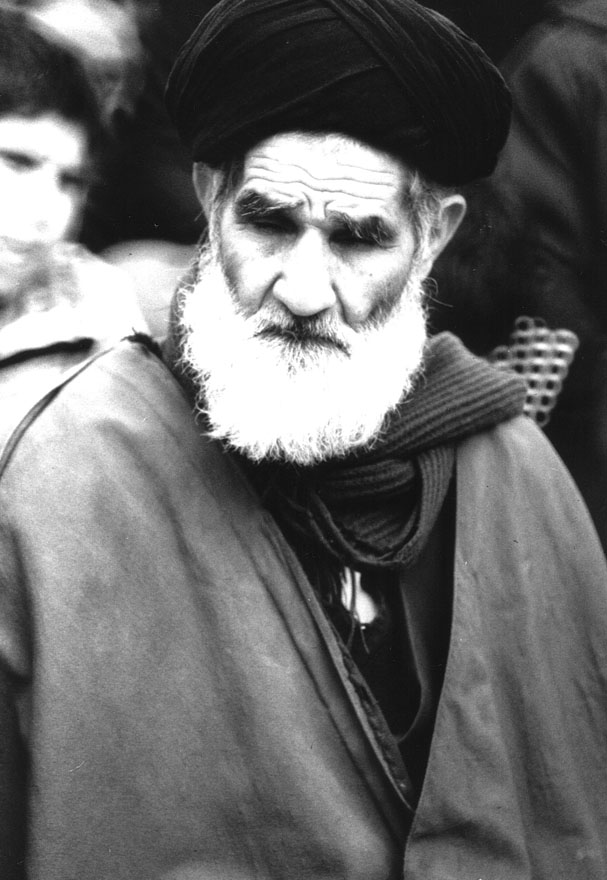
An elderly blind cleric Urban Migration
A main characteristic of the working class has been its peasant origins.
The rapid growth of the working class in the 1960s and 1970s was the result
of migration from villages to cities. There also has been some migration
from small towns to larger cities and from economically depressed areas,
such as Baluchestan and Kordestan, to more economically vital regions.
The result of these population transfers has been an inability of urban
services to keep pace with the population growth and the consequent spread
of slum areas. In 1987 south Tehran was still Iran's most extensive urban
slum, but other large cities also had notable slum sections. It was in
these areas that marginally employed and unskilled workers were concentrated.
Immediately after the Revolution, the government announced its intention
of making living and working conditions in rural areas more attractive
as a means of stemming rural- to-urban migration. Although the slowdown
in the economy since the Revolution may have contributed to a generally
reduced rate of urban growth, there was no evidence that migration from
the villages had ceased. The preliminary results from the 1986 census indicated
that such cities as Mashhad and Shiraz have grown at even faster rates
than before the Revolution.
Rural Society
At the time of the Revolution there were about 68,000 villages in Iran.
They varied from mere hamlets of a few families up to sizable settlements
with populations of 5,000. Social organization in these villages was less
stratified than in urban areas, but a hierarchy of political and social
relationships and patterns of interaction could be identified. At the top
of the village social structure was the largest landowner or owners. In
the middle stratum were peasants owning medium to small farms. In the larger
villages the middle stratum also included local merchants and artisans.
The lowest level, which predominated in most villages, consisted of landless
villagers.
Immediately before the Revolution in 1979, Iran's agriculturally productive
land totaled about 16.6 million hectares. Approximately one- half of this
land was owned by some 200,000 absentee landlords who resided in urban
areas. Such owners were represented in the villages by agents who themselves
were generally large landowners. The property of the large-scale owners
tended to be among the most fertile in the country and generally was used
for the production of such cash crops as cotton, sugar beets, fruit, and
high-demand vegetables. Agricultural workers were recruited from among
the landless villagers and were given either a share of the crop or a cash
wage. In some cases, landlords contracted with small peasant owners to
farm their fields in return for a share of the crop. Such agreements netted
for the landlords from 20 to 70 percent of the harvest, depending upon
the crop and the particular inputs provided by the respective parties.
In 1979 about 7 million hectares were divided among approximately 2
million peasant families, whose holdings ranged from less than 1 hectare
up to 50. They had acquired ownership as a result of a land reform program
implemented between 1962 and 1971. In a typical village a few families
owned sufficient land -- ten or more hectares -- to engage in farming for
profit. About 75 percent of the peasant owners, however, had less than
7 hectares, an amount generally insufficient for anything but subsistence
agriculture.
Approximately 50 percent of all villagers owned no land. Within individual
villages the landless population varied from as little as 10 percent of
the total to more than 75 percent. The landless villagers were composed
of three distinct social groups: village merchants, village artisans and
service workers, and agricultural laborers. Village merchants were found
primarily in the larger villages. Their interests tended to coincide with
those of the peasant owners, and it was not uncommon for the better-off
merchants to acquire agricultural landholdings. Village artisans included
blacksmiths, carpenters, cobblers, and coppersmiths. The increasing availability
of urban-manufactured goods throughout the 1960s and 1970s had caused a
sharp decline in the numbers of village artisans, although carpenters were
still important in the larger villages.
The largest group of landless villagers consisted of agricultural laborers
who subsisted by contracting with landlords and larger peasant owners to
work in their fields on a daily or seasonal basis. In return for their
labor they received a wage, based upon the nature of the work performed,
or, in some cases, a share of the crop. This group also provided many of
the migrants from rural areas in the 1970s. In some areas the migration
rate was so great that landlords were compelled to import foreign workers,
primarily unskilled Afghans, to work their lands. The Afghan and other
foreign workers were rounded up immediately after the Revolution and expelled
from Iran.
Traditionally, in each village the kadkhuda
-- not to be confused with the head of the smallest tribal unit, a clan
-- was responsible for administering its affairs and for representing the
village in relations with governmental authorities and other outsiders.
Before land reform, landlords appointed the kadkhudas from among the peasants.
Sometimes kadkhudas also served as the landlord's agent in the village,
although the tendency was for these two positions to be filled by separate
persons. After land reform, the office of kadkhuda became, at least in
theory, elective. However, since the kadkhuda was the primary channel through
which the government transacted its affairs with the villages, any villager
desiring to be a kadkhuda had to demonstrate that he had sufficient political
access to government officials in the nearest town to protect the interests
of the village. In effect, this meant that kadkhudas were actually selected
by government officials. In general, "elected" kadkhudas tended to
be among the richest peasant landowners. The land reform and various rural
development programs undertaken prior to the Revolution did not produce
positive results for the majority of villagers. Economic conditions for
most village families stagnated or deteriorated precisely at the time that
manufacturing and construction were experiencing an economic boom in urban
areas. Consequently, there was a significant increase in rural-to- urban
migration. Between the 1966 and the 1976 censuses, a period when the population
of the country as a whole was growing at the rate of 2.7 percent per year,
most villages actually lost population, and the overall growth rate for
the rural population was barely 0.5 percent annually. This migration was
primarily of young villagers attracted to cities by the prospect of seasonal
or permanent work opportunities. By the late 1970s, this migration had
seriously depleted the labor force of many villages. This was an important
factor in the relative decline in production of such basic food crops as
cereals because many farming families were forced to sow their agricultural
land with
The problems of rural stagnation and agricultural decline had already
surfaced in public debate by the eve of the Revolution. During the immediate
turmoil surrounding the fall of the monarchy, peasants in many villages
took advantage of the unsettled conditions to complete the land redistribution
begun under the shah, i.e., they expropriated the property of landlords
whom they accused of being un-Islamic. In still other villages, former
landlords who had lost property as a result of land reform tried to regain
it by flaunting their commitment to Islam and their antagonism to the deposed
shah.
Thus, from the beginning the republican government was compelled to
tackle the land problem. This proved to be a difficult issue because of
the differences among the political elite with respect to the role of private
property under Islam. Some officials wanted to legitimize the peasant expropriations
as a means of resolving the problem of inequitable land distribution resulting
from the shah's land reform program. Such officials generally believed
in the principle that the peasant who actually tilled the soil should also
be the owner. In contrast, other officials opposed legitimizing land expropriations
on the ground that private property is both sanctioned and protected by
Islamic law. By 1987 no consensus had been reached, and the question of
land redistribution remained unresolved.
The government, however, has demonstrated considerable interest in rural
development. A new organization for rebuilding villages, the Crusade for
Reconstruction (Jihad-e Sazandegi or Jihad), was created in 1979. It consisted
of high-school-educated youth, largely from urban areas, who were charged
with such village improvement tasks as providing electrification and piped
water, building feeder roads, constructing mosques and bath houses, and
repairing irrigation networks.
Nomadic Society
There has never been a census of pastoral nomads in Iran. In 1986 census
officials estimated that nomads totaled 1.8 million. The number of tribally
organized people, both nomadic and sedentary, may be twice that figure,
or nearly 4 million. The nomadic population practices transhumance, migrating
in the spring and in the fall. Each tribe claims the use of fixed territories
for its summer and winter pastures and the right to use a specified migration
route between these areas. Frequently summer and winter camps are widely
separated, in some cases by as much as 300 kilometers. Consequently, the
semiannual migrations, with families, flocks, and household equipment,
may take up to two months to complete. The nomadic tribes are concentrated
in the Zagros, but small groups are also found in northeastern and southeastern
Iran.
The movements of the tribes appear to be an adaptation to the ecology
of the Zagros. In the summer, when the low valleys are parched from insufficient
rainfall, the tribes are in the higher elevations. When the snows begin
to fall and cover the pastures of the higher valleys, the tribes migrate
to low-lying pastures that remain green throughout the winter because of
the seasonal rainfall.
Traditionally, the nomadic tribes have kept large herds of sheep and
goats, which have provided the main source of red meat for Iran. During
migrations the tribes trade their live animals, wool, hair, hides, dairy
products, and various knotted and woven textiles with villagers and townspeople
in return for manufactured and agricultural goods that the nomads are unable
to produce. This economic interdependence between the nomadic and settled
populations of Iran has been an important characteristic of society for
several centuries.
During the Qajar period (1795-1925), when the central government was
especially weak, the nomadic tribes formed tribal confederations and acquired
a great deal of power and influence. In many areas these tribal confederations
were virtually autonomous and negotiated with the local and national governments
for extensive land rights. The largest tribal confederations, such as those
of the Bakhtiari and the Qashqai, were headed by a paramount leader, or
ilkhan. Individual tribes within a confederation were headed by a khan,
beg, shaykh, or sardar. Subtribes, generally composed of several clans,
were headed by kalantars. The head of the smallest tribal unit, the clan,
was called a kadkhuda.
Reza Shah moved against the tribes with the new national army that he
began creating while minister of war and prime minister (1921-25). After
he became shah, his tribal policy had two objectives: to break the authority
and power of the great tribal confederation leaders, whom he perceived
as a threat to his goal of centralizing power, and to gain the allegiance
of urban political leaders who had historically resented the power of the
tribes. In addition to military maneuvers against the tribes, Reza Shah
used such economic and administrative techniques as confiscation of tribal
properties and the holding of chiefs' sons as hostages. Eventually, many
nomads were subdued and placed under army control. Some were given government-built
houses and forced to follow a sedentary life. As a result, the herds kept
by the nomads were unable to obtain adequate pasturage, and there was a
drastic decline in livestock. When Reza Shah abdicated in 1941, many nomadic
tribes returned to their former life-styles.
Mohammad Reza Shah continued the policy of weakening the political power
of the nomadic tribes, but efforts to coerce them to settle were abandoned.
Several tribal leaders were exiled, and the military was given greater
authority to regulate tribal migrations. Tribal pastures were nationalized
during the 1960s as a means of permitting the government to control access
to grazing. In addition, various educational, health, and vocational training
programs were implemented to encourage the tribes to settle voluntarily.
Following the Revolution, several former tribal leaders attempted to
revitalize their tribes as major political and economic forces. Many factors
impeded this development, including the hostile attitude of the central
government, the decline in nomadic populations as a result of the settlement
of large numbers of tribespeople in the 1960s and 1970s, and the consequent
change in attitudes, especially of youth raised in villages and towns.
By the mid-1980s, it seemed that the nomadic tribes were no longer a
political force in Iranian society. For one thing, the central government
had demonstrated its ability to control the migration routes. Moreover,
the leadership of the tribes, while formally vested in the old families,
effectively was dispersed among a new generation of nonelite tribespeople
who tended to see themselves as ethnic minorities and did not share the
views of the old elite.
For most Iranians the reciprocal obligations and privileges that define
relations between kinsfolk -- from the parent-child bond to more distant
ones -- have been more important than those associated with any other kind
of social alignment. Economic, political, and other forms of institutional
activity have been significantly colored by family ties. This has been
true not only for the nuclear family of parents and offspring but also
for the aggregate kinsfolk, near and distant, who together represent the
extended family at its outermost boundary.
Historically, an influential family was one that had its members strategically
distributed throughout the most vital sectors of society, each prepared
to support the others in order to ensure family prestige and family status.
Since the Revolution, this has meant that each of the elite families of
Tehran and the major provincial centers included a cadre of clergy, bureaucrats,
and Pasdaran (Pasdaran-e Enghelab-e Islami, or Islamic Revolutionary Guard
Corps, or Revolutionary Guards). Business operations have continued to
be family affairs; often large government loans for business ventures have
been obtained simply because the owners were recognized as members of families
with good Islamic and revolutionary credentials. Political activities also
followed family lines. Several brothers or first cousins might join the
Islamic Republican Party. Another group of siblings might become members
of a clandestine opposition group such as the Mojahedin (Mojahedin-e Khalq,
or People's Struggle). Similarly, one member of a family might join the
clergy, another the Pasdaran or the armed forces. Successful members were
expected to assist less successful ones to get their start. Iranians have
viewed this inherent nepotism as a positive value, not as a form of corruption.
A person without family ties has little status in the society at large.
The severing of ties is acceptable only if a family member has done something
repugnant to Islam. Even then, the family is
Religious law supports the sanctity of the family in diverse ways, defining
the conditions for marriage, divorce, inheritance, and guardianship. Additional
laws have been passed by the Majlis that reinforce and refine religious
law and are designed to protect the integrity of the family .
The head of the household -- the father and the husband -- expects obedience
and respect from others in the family. In return, he is obligated to support
them and to satisfy their spiritual, social, and material needs. In practice,
he is more a strict disciplinarian. He also may be a focus of love and
affection, and family members may feel a strong sense of duty toward him.
Considerable conflict and irresolution have resulted in many families,
especially in urban areas, because young Iranians, imbued with revolutionary
religious views or secular values, have not been able to reconcile these
new ideas with the traditional values of their fathers.
Marriage regulations are defined by Shia religious law, although non-Shias
are permitted to follow their own religious practices. Before the Revolution,
the legal marriage age was eighteen for females and twenty- one for males,
although in practice most couples, especially among lower- class urban
and rural families, actually were younger than the law permitted when they
married. Consequently, the average marriage age for both sexes was 18.9
years. Since the Revolution, the minimum legal age for marriage for both
males and females has been lowered to fifteen and thirteen years, respectively,
although even younger boys and girls may be married with the permission
of their fathers. The average age of marriage is believed to have fallen
as a result of official encouragement of earlier marriages.
The selection of a marriage partner is normally determined by customary
preference, economic circumstances, and geographic considerations. Among
the Christians, Jews, and Zoroastrians, the choice may be restricted by
religious practice. There is a distinct preference for marriage within
extended kin networks, and a high incidence of marriages among first and
second cousins exists. A traditionally preferred marriage is between the
children of two brothers, although this kind of consanguineous marriage
was declining among the old regime elite and secular middle class by the
eve of the Revolution.
Marriage arrangements in villages and among the lower and traditional
middle classes of urban areas tend to follow traditional patterns. When
a young man is judged ready for marriage, his parents will visit the parents
of a girl whom they believe to be a suitable match. In many cases, the
man will have already expressed an interest in the girl and have asked
his parents to begin these formalities. If the girl's parents show similar
interest in the union, the conversation quickly turns to money. There must
be an agreement on the amont of the bride-price that will be given to the
bride's family at the time of marriage. In principle this payment is supposed
to compensate the girl's family for her loss, but in practice it is used
primarily to finance the cost of the wedding. The exact sum varies according
to the wealth, social position, and degree of kinship of the two families.
Once the two families have agreed to the marriage, the prospective bride
and groom are considered engaged. The courtship period now commences and
may extend for a year or more, although generally the engagement lasts
less than twelve months. The actual wedding involves a marriage ceremony
and a public celebration. The ceremony is the signing of a marriage contract
in the presence of a mullah. One significant
feature of the marriage contract is the mahriyeh, a stipulated sum that
the groom gives to his new bride. The mahriyeh usually is not paid at the
time of the marriage, especially in marriages between cousins. The contract
notes that it is to be paid, however, in the event of divorce or, in case
of the husband's death, to be deducted from his estate before the inheritance
is divided according to religious law. If the mahriyeh is waived, as sometimes
happens in urban areas, this too must be stipulated in the marriage contract.
Marriage customs among the secularized middle and upper classes tend
to follow practices in the United States and Europe. The prenuptial bride-price
may be paid in installments or even eliminated altogether, especially if
a substantial mahriyeh is guaranteed. It is typical for the marriage partners
to have chosen one another. The bride and groom usually sit together at
the reception, to which both male and female guests are invited.
Polygyny in Iran is regulated by Islamic custom, which permits a man
to have as many as four wives simultaneously, provided that he treats them
equally. During the reign of Mohammad Reza Shah, the government attempted
to discourage polygyny through legal restrictions, such as requiring the
permission of the first wife before the state would register a second marriage.
The practice of kin marriages also tended to work against polygynous marriages,
since families would exert pressure on men not to take a second wife. No
reliable figures existed on the number of polygynous marriages in the 1960s
and 1970s, but they were believed to be on the decline and largely confined
to the older generation. After the Revolution, the republican government
abolished the secular codes relating to marriage and decreed polygyny acceptable
as long as such marriages were in accordance with Shia religious law.
Shia Islam, unlike Sunni Islam, also recognizes a special form of temporary
marriage called muta. In a muta marriage, the man and woman sign a contract
agreeing to live together as husband and wife for a specified time, which
can be as brief as several hours or as long as ninety-nine years. The man
agrees to pay a certain amount of money for the duration of the contract.
Provision is also made for the support of any offspring. There is no limit
on the number of muta marriages that a man may contract. Traditionally,
muta marriages have been common in Shia pilgrimage centers such as Mashhad
and An Najaf in Iraq. Under the monarchy, the government refused to grant
any legal recognition to muta marriages in an effort to discourage the
practice. Since the Revolution, however, muta marriages have again become
acceptable.
Under both Islamic law and traditional practice, divorce in Iran historically
has been easier for a man to obtain than for a woman. Men could exercise
the right of repudiation of wives according to the guidelines of Islamic
law. Women were permitted to leave their husbands on narrowly defined grounds,
such as insanity or impotence. Beginning in the mid-1960s, the royal government
attempted to broaden the grounds upon which women could seek divorce through
the Family Protection Law. This legislation was frequently criticized by
the clergy and was one of the first laws abrogated after the Revolution.
In 1985, however, legislation was passed permitting women to initiate divorce
proceedings in certain limited circumstances.
Statistics on divorce since the Revolution were unavailable in early
1987. The government claimed that the divorce rate in Iran was much lower
than in industrialized countries. Furthermore, members of the clergy have
preached that divorce is "reprehensible" under Islam even though it is
tolerated.
Traditional Attitudes Toward Segregation of
the Sexes
With the notable exception of the Westernized and secularized upper
and middle classes, Iranian society before the Revolution practiced public
segregation of the sexes. Women generally practiced use of the chador (or
veil) when in public or when males not related to them were in the house.
In the traditional view, an ideal society was one in which women were confined
to the home, where they performed the various domestic tasks associated
with managing a household and rearing children. Men worked in the public
sphere, that is, in the fields, factories, bazaars, and offices. Deviations
from this ideal, especially in the case of women, tended to reflect adversely
upon the reputation of the family. The strength of these traditional attitudes
was reflected in the public education system, which maintained separate
schools for boys and girls from the elementary through the secondary levels.
The traditional attitudes on the segregation of women clashed sharply
with the views and customs of the secularized upper and middle classes,
especially those in Tehran. Mixed gatherings, both public and private,
were the norm. During the Pahlavi era the government was the main promoter
of change in traditional attitudes toward sexual segregation. It sought
to discourage veiling of women at official functions and encouraged mixed
participation in a variety of public gatherings. The result was to bring
the government into social conflict with the Shia clergy, who sought to
defend traditional values.
Impact of Western Ideas on the Role of Women
Among the ideas imported into Iran from the West was the notion that
women should participate in the public sphere. The Pahlavi government encouraged
women to get as much education as possible and to participate in the labor
force at all levels. After 1936, when Reza Shah banned the chador, veiling
came to be perceived among the minority of elite and secular middle-class
women as a symbol of oppression. Before the Revolution, Iranian society
was already polarized between the traditionally minded majority and a minority
of involved women who were dedicated to improving the status of women.
As early as 1932, Iranian women held a meeting of the Oriental Feminine
Congress in Tehran at which they called for the right of women to vote,
compulsory education for both boys and girls, equal salaries for men and
women, and an end to polygyny. In 1963 women were given the right to vote
and to hold public office.
Female Participation in the Work Force
Prior to the Revolution, three patterns of work existed among women.
Among the upper classes, women either worked as professionals or undertook
voluntary projects of various kinds. Whereas secular middle- class women
aspired to emulate such women, traditional middle-class women worked outside
the home only from dire necessity. Lower class women frequently worked
outside the home, especially in major cities, because their incomes were
needed to support their households.
Women were active participants in the Revolution that toppled the shah.
Most activists were professional women of the secular middle classes, from
among whom political antagonists to the regime had long been recruited.
Like their male counterparts, such women had nationalist aspirations and
felt that the shah's regime was a puppet of the United States. Some women
also participated in the guerrilla groups, especially the Mojahedin and
the Fadayan. More significant, however, were the large numbers of lower
class women in the cities who participated in street demonstrations during
the latter half of 1978 and early 1979. They responded to the call of Khomeini
that it was necessary for all Muslims to demonstrate their opposition to
tyranny.
Following the Revolution, the status of women changed. The main social
group to inherit political power -- the traditional middle class -- valued
most highly the traditional role of women in a segregated society. Accordingly,
laws were enacted to restrict the role of women in public life; these laws
affected primarily women of the secularized middle and upper classes. Hejab,
or properly modest attire for women, became a major issue. Although it
was not mandated that women who had never worn a chador would have to wear
this garment, it was required that whenever women appeared in public they
had to have their hair and skin covered, except for the face and hands.
The law has been controversial among secularized women, although for the
majority of women, who had worn the chador even before the Revolution,
the law probably has had only negligible impact.
Esfahan women attend a literacy class concerned
with home economics The overwhelming majority of Iranians -- at least 90 percent of the
total population -- are Muslims who adhere to Shia Islam. In contrast,
the majority of Muslims throughout the world follow Sunni Islam. Of the
several Shia sects, the Twelve Imam or
Twelver (ithna-ashari), is dominant in Iran; most Shias in Bahrain, Iraq,
and Lebanon also follow this sect. All the Shia sects originated among
early Muslim dissenters in the first three centuries following the death
of the Prophet Muhammad in A.D. 632.
The principal belief of Twelvers, but not of other Shias, is that the
spiritual and temporal leadership of the Muslim community passed from Muhammad
to Ali and then sequentially to eleven of Ali's direct male descendants,
a tenet rejected by Sunnis. Over the centuries various other theological
differences have developed between Twelver Shias and Sunnis.
Shia Islam in Iran
Distinctive Beliefs
Although Shias have lived in Iran since the earliest days of Islam,
and there was one Shia dynasty in part of Iran during the tenth and eleventh
centuries, it is believed that most Iranians were Sunnis until the seventeenth
century. The Safavid dynasty made Shia Islam the official state religion
in the sixteenth century and aggressively proselytized on its behalf. It
is also believed that by the mid-seventeenth century most people in what
is now Iran had become Shias, an affiliation that has continued.
All Shia Muslims believe there are seven pillars of faith, which detail
the acts necessary to demonstrate and reinforce faith. The first five of
these pillars are shared with Sunni Muslims. They are shahada, or the confession
of faith; namaz, or ritualized prayer; zakat, or almsgiving; sawm, fasting
and contemplation during daylight hours during the lunar month of Ramazan;
and hajj, or pilgrimage to the holy cities of Mecca and Medina once in
a lifetime if financially feasible. The other two pillars, which are not
shared with Sunnis, are jihad -- or crusade to protect Islamic lands, beliefs,
and institutions, and the requirement to do good works and to avoid all
evil thoughts, words, and deeds.
Twelver Shia Muslims also believe in five basic principles of faith:
there is one God, who is a unitary divine being in contrast to the trinitarian
being of Christians; the Prophet Muhammad is the last of a line of prophets
beginning with Abraham and including Moses and Jesus, and he was chosen
by God to present His message to mankind; there is a resurrection of the
body and soul on the last or judgment day; divine justice will reward or
punish believers based on actions undertaken through their own free will;
and Twelve Imams were successors to Muhammad. The first three of these
beliefs are also shared by non- Twelver Shias and Sunni Muslims.
The distinctive dogma and institution of Shia Islam is the Imamate,
which includes the idea that the successor of Muhammad be more than merely
a political leader. The Imam must also be a spiritual leader, which means
that he must have the ability to interpret the inner mysteries of the Quran
and the shariat. The Twelver Shias
further believe that the Twelve Imams who succeeded the Prophet were sinless
and free from error and had been chosen by God through Muhammad.
The Imamate began with Ali, who is also accepted by Sunni Muslims as
the fourth of the "rightly guided caliphs" to succeed the Prophet. Shias
revere Ali as the First Imam, and his descendants, beginning with his sons
Hasan and Husayn (also seen as Hosein), continue the line of the Imams
until the Twelfth, who is believed to have ascended into a supernatural
state to return to earth on judgment day. Shias point to the close lifetime
association of Muhammad with Ali. When Ali was six years old, he was invited
by the Prophet to live with him, and Shias believe Ali was the first person
to make the declaration of faith in Islam. Ali also slept in Muhammad's
bed on the night of the hijra, or migration from Mecca to Medina, when
it was feared that the house would be attacked by unbelievers and the Prophet
stabbed to death. He fought in all the battles Muhammad did except one,
and the Prophet chose him to be the husband of his favorite daughter, Fatima.
In Sunni Islam an imam is the leader of congregational prayer. Among
the Shias of Iran the term imam traditionally has been used only for Ali
and his eleven descendants. None of the Twelve Imams, with the exception
of Ali, ever ruled an Islamic government. During their lifetimes, their
followers hoped that they would assume the rulership of the Islamic community,
a rule that was believed to have been wrongfully usurped. Because the Sunni
caliphs were cognizant of this hope, the Imams generally were persecuted
during the Umayyad and Abbasid dynasties. Therefore, the Imams tried to
be as unobtrusive as possible and to live as far as was reasonable from
the successive capitals of the Islamic empire.
During the ninth century Caliph Al Mamun, son of Caliph Harun ar Rashid,
was favorably disposed toward the descendants of Ali and their followers.
He invited the Eighth Imam, Reza (A.D. 765-816), to come from Medina to
his court at Marv (Mary in the present-day Soviet Union). While Reza was
residing at Marv, Mamun designated him as his successor in an apparent
effort to avoid conflict among Muslims. Reza's sister Fatima journeyed
from Medina to be with her brother but took ill and died at Qom. A shrine
developed around her tomb, and over the centuries Qom has become a major
Shia pilgrimage and theology center.
Mamun took Reza on his military campaign to retake Baghdad from political
rivals. On this trip Reza died unexpectedly in Khorasan. Reza was the only
Imam to reside or die in what is now Iran. A major shrine, and eventually
the city of Mashhad, grew up around his tomb, which has become the most
important pilgrimage center in Iran. Several important theological schools
are located in Mashhad, associated with the shrine of the Eighth Imam.
Reza's sudden death was a shock to his followers, many of whom believed
that Mamun, out of jealousy for Reza's increasing popularity, had him poisoned.
Mamun's suspected treachery against Reza and his family tended to reinforce
a feeling already prevalent among his followers that the Sunni rulers were
untrustworthy.
The Twelfth Imam is believed to have been only five years old when the
Imamate descended upon him in A.D. 874 at the death of his father. The
Twelfth Imam is usually known by his titles of Imam-e Asr (the Imam of
the Age) and Sahib az Zaman (the Lord of Time). Because his followers feared
he might be assassinated, the Twelfth Imam was hidden from public view
and was seen only by a few of his closest deputies. Sunnis claim that he
never existed or that he died while still a child. Shias believe that the
Twelfth Imam remained on earth, but hidden from the public, for about seventy
years, a period they refer to as the lesser occultation (gheybat-e sughra).
Shias also believe that the Twelfth Imam has never died, but disappeared
from earth in about A.D. 939. Since that time the greater occultation (gheybat-e
kubra) of the Twelfth Imam has been in force and will last until God commands
the Twelfth Imam to manifest himself on earth again as the Mahdi, or Messiah.
Shias believe that during the greater occultation of the Twelfth Imam he
is spiritually present -- some believe that he is materially present as
well -- and he is besought
The Shia doctrine of the Imamate was not fully elaborated until the
tenth century. Other dogmas were developed still later. A characteristic
of Shia Islam is the continual exposition and reinterpretation of doctrine.
The most recent example is Khomeini's expounding of the doctrine of velayat-e
faqih, or the political guardianship of the community of believers
by scholars trained in religious law. This has not been a traditional idea
in Shia Islam and is, in fact, an innovation. The basic idea is that the
clergy, by virtue of their superior knowledge of the laws of God, are the
best qualified to rule the society of believers who are preparing themselves
on earth to live eternally in heaven. The concept of velayat-e faqih thus
provides the doctrinal basis for theocratic government, an experiment that
Twelver Imam Shias had not attempted prior to the Iranian Revolution in 1979.
Religious Obligations
In addition to the seven principal tenets of faith, there are also traditional
religious practices that are intimately associated with Shia Islam. These
include the observance of the month of martyrdom, Moharram, and pilgrimages
to the shrines of the Twelve Imams and their various descendants. The Moharram
observances commemorate the death of the Third Imam, Husayn, who was the
son of Ali and Fatima and the grandson of Muhammad. He was killed near
Karbala in modern Iraq in A.D. 680 during a battle with troops supporting
the Umayyad caliph. Husayn's death is commemorated by Shias with passion
plays and is an intensely religious time.
Pilgrimage to the shrines of Imams is a specific Shia custom. The most
important shrines in Iran are those for the Eighth Imam in Mashhad and
for his sister Fatima in Qom. There are also important secondary shrines
for other relatives of the Eighth Iman in Rey, adjacent to south Tehran,
and in Shiraz. In virtually all towns and in many villages there are numerous
lesser shrines, known as imamzadehs, which commemorate descendants of the
imams who are reputed to have led saintly lives. Shia pilgrims visit these
sites because they believe that the imams and their relatives have power
to intercede with God on behalf of petitioners. The shrines in Iraq at
Karbala and An Najaf are also revered by Shias.
Religious Institutions and Organizations
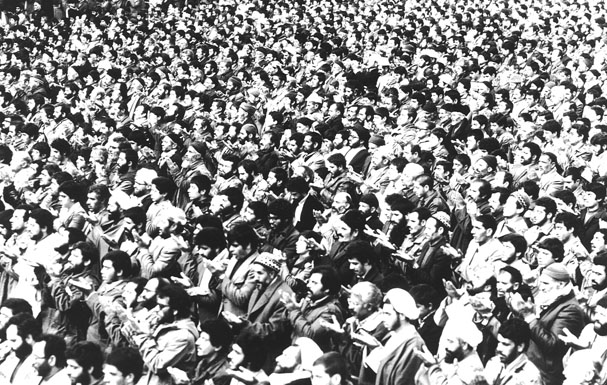
A prayer meeting at the University of Theran Historically, the single most important religious institution in Iran
has been the mosque. In towns, congregational prayers, as well as prayers
and rites associated with religious observances and important phases in
the lives of Muslims, took place in mosques. Iranian Shias before the Revolution
did not generally attach great significance to institutionalization, however,
and there was little emphasis on mosque attendance, even for the Friday
congregational prayers. Mosques were primarily an urban phenomenon, and
in most of the thousands of small villages there were no mosques. Mosques
in the larger cities began to assume more important social roles during
the 1970s; during the Revolution they played a prominent role in organizing
people for the large demonstrations that took place in 1978 and 1979. Since
that time their role has continued to expand, so that in 1987 mosques played
important political and social roles as well as religious ones.
Another religious institution of major significance was a special building
known as a hoseiniyeh. Hoseiniyehs existed in urban areas and traditionally
served as sites for recitals commemorating the martyrdom of Husayn, especially
during the month of Moharram. In the 1970s, some hoseiniyehs, such as the
Hoseiniyeh Irshad in Tehran, became politicized as prominent clerical and
lay preachers used the symbol of the deaths as martyrs of Husayn and the
other Imams as thinly veiled criticism of Mohammad Reza Shah's regime,
thus helping to lay the groundwork for the Revolution in 1979.
Institutions providing religious education include madrasehs and maktabs.
Madrasehs, or seminaries, historically have been important for advanced
training in Shia theology and jurisprudence. Madrasehs are generally associated
with noted Shia scholars who have attained the rank of ayatollah. There
are also some older madrasehs, established initially through endowments,
at which several scholars may teach. Students, known as talabehs, live
on the grounds of the madrasehs and are provided stipends for the duration
of their studies, usually a minimum of seven years, during which they prepare
for the examinations that qualify a seminary student to be a low-level
preacher, or mullah. At the time of the Revolution, there were slightly
more than 11,000 talabehs in Iran; approximately 60 percent of these were
studying at the madrasehs in the city of Qom, another 25 percent were enrolled
in the important madrasehs of Mashhad and Esfahan, and the rest were at
madrasehs in Tabriz, Yazd, Shiraz, Tehran, Zanjan, and other cities.
Maktabs, primary schools run by the clergy, were the only educational
institutions prior to the end of the nineteenth century when the first
secular schools were established. Maktabs declined in numbers and importance
as the government developed a national public school system beginning in
the 1930s. Nevertheless, maktabs continued to exist as private religious
schools right up to the Revolution. Since 1979 the public education system
has been desecularized and the maktabs and their essentially religious
curricula merged with government schools.
Another major religious institution in Iran is the shrine. There are
more than 1,100 shrines that vary from crumbling sites associated with
local saints to the imposing shrines of Imam Reza and his sister Fatima
in Mashhad and Qom, respectively. These more famous shrines are huge complexes
that include the mausoleums of the venerated Eighth Imam and his sister,
tombs of former shahs, mosques, madrasehs, and libraries. Imam Reza's shrine
is the largest and is considered to be the holiest. In addition to the
usual shrine accoutrements, Imam Reza's shrine contains hospitals, dispensaries,
a museum, and several mosques located in a series of courtyards surrounding
his tomb. Most of the present shrine dates from the early fourteenth century,
except for the dome, which was rebuilt after being damaged in an earthquake
in 1673. The shrine's endowments and gifts are the largest of all religious
institutions in the country. Traditionally, free meals for as many as 1,000
people per day are provided at the shrine. Although there are no special
times for visiting this or other shrines, it is customary for pilgrimage
traffic to be heaviest during Shia holy periods. It has been estimated
that more than 3 million pilgrims visit the shrine annually.
Visitors to Imam Reza's shrine represent all socioeconomic levels. Whereas
piety is a motivation for many, others come to seek the spiritual grace
or general good fortune that a visit to the shrine is believed to ensure.
Commonly a pilgrimage is undertaken to petition Imam Reza to act as an
intermediary between the pilgrim and God. Since the nineteenth century,
it has been customary among the bazaar class and members of the lower classes
to recognize those who have made a pilgrimage to Mashhad by prefixing their
names with the title mashti.
The next most important shrine is that of Imam Reza's sister, Fatima,
known as Hazarat-e Masumeh (the Pure Saint). The present shrine dates from
the early sixteenth century, although some later additions, including the
gilded tiles, were affixed in the early nineteenth century. Other important
shrines are those of Shah Abdol Azim, a relative of Imam Reza, who is entombed
at Rey, near Tehran, and Shah Cheragh, a brother of Imam Reza, who is buried
in Shiraz. A leading shrine honoring a person not belonging to the family
of Imams is that of the Sufi master Sayyid Nimatollah Vali near Kerman.
Shias make pilgrimages to these shrines and the hundreds of local imamzadehs
to petition the saints to grant them special favors or to help them through
a period of troubles.
Because Shias believe that the holy Imams can intercede for the dead
as well as for the living, cemeteries traditionally have been located adjacent
to the most important shrines in both Iran and Iraq. Corpses were transported
overland for burial in Karbala in southern Iraq until the practice was
prohibited in the 1930s. Corpses are still shipped to Mashhad and Qom for
burial in the shrine cemeteries of these cities.
The constant movement of pilgrims from all over Iran to Mashhad and
Qom has helped bind together a linguistically heterogeneous population.
Pilgrims serve as major sources of information about conditions in different
parts of the country and thus help to mitigate the parochialism of the
regions.
A traditional source of financial support for all religious institutions
has been the vaqf, a religious endowment by which land and other income-producing
property is given in perpetuity for the maintenance of a shrine, mosque,
madraseh, or charitable institution such as a hospital, library, or orphanage.
A mutavalli administers a vaqf in accordance with the stipulations in the
donor's bequest. In many vaqfs the position of mutavalli is hereditary.
Under the Pahlavis, the government attempted to exercise control over the
administration of vaqfs, especially those of the larger shrines. This was
a source of conflict with the clergy, who perceived the government's efforts
as lessening their influence and authority in traditional religious matters.
The government's interference with the administration of vaqfs led to
a sharp decline in the number of vaqf bequests. Instead, wealthy and pious
Shias chose to give financial contributions directly to the leading ayatollahs
in the form of zakat, or obligatory alms. The clergy in turn used the funds
to administer their madrasehs and to institute various educational and
charitable programs, which indirectly provided them with more influence
in society. The access of the clergy to a steady and independent source
of funding was an important factor in their ability to resist state controls
and ultimately helped them direct the opposition to the shah.
Religious Hierarchy
From the time that Twelver Shia Islam emerged as a distinct religious
denomination in the early ninth century, its clergy, or ulama, have played
a prominent role in the development of its scholarly and legal tradition;
however, the development of a distinct hierarchy among the Shia clergy
dates back only to the early nineteenth century. Since that time the highest
religious authority has been vested in the mujtahids, scholars who by virtue
of their erudition in the science of religion (the Quran, the traditions
of Muhammad and the imams, jurisprudence, and theology) and their attested
ability to decide points of religious conduct, act as leaders of their
community in matters concerning the particulars of religious duties. Lay
Shias and lesser members of the clergy who lack such proficiency are expected
to follow mujtahids in all matters pertaining to religion, but each believer
is free to follow any mujtahid he chooses. Since the mid-nineteenth century
it has been common for several mujtahids concurrently to attain prominence
and to attract large followings. During the twentieth century, such mujtahids
have been accorded the title of ayatollah. Occasionally an ayatollah achieves
almost universal authority among Shias and is given the title of ayatollah
ol ozma, or grand ayatollah. Such authority was attained by as many as
seven mujtahids simultaneously, including Ayatollah Khomeini, in the late
1970s.
To become a mujtahid, it is necessary to complete a rigorous and lengthy
course of religious studies in one of the prestigious madrasehs of Qom
or Mashhad in Iran or An Najaf in Iraq and to receive an authorization
from a qualified mujtahid. Of equal importance is either the explicit or
the tacit recognition of a cleric as a mujtahid by laymen and scholars
in the Shia community. There is no set time for studying a particular subject,
but serious preparation to become a mujtahid normally requires fifteen
years to master the religious subjects deemed essential. It is uncommon
for any student to attain the status of mujtahid before the age of thirty;
more commonly students are between forty and fifty years old when they
achieve this distinction.
Most seminary students do not complete the full curriculum of studies
to become mujtahids. Those who leave the madrasehs after completing the
primary level can serve as prayer leaders, village mullahs, local shrine
administrators, and other religious functionaries. Those who leave after
completing the second level become preachers in town and city mosques.
Students in the third level of study are those preparing to become mujtahids.
The advanced students at this level are generally accorded the title of
hojjatoleslam when they have completed all their studies.
The Shia clergy in Iran wear a white turban and an aba, a loose, sleeveless
brown cloak, open in front. A sayyid, who is a clergyman descended from
Muhammad, wears a black turban and a black aba.
Unorthodox Shia Religious Movements
Shah Ismail, the founder of the Safavid dynasty, who established Twelver
Shia Islam as the official religion of Iran at the beginning of the sixteenth
century, was revered by his followers as a Sufi master. Sufism, or Islamic
mysticism, has a long tradition in Iran. It developed there and in other
areas of the Islamic empire during the ninth century among Muslims who
believed that worldly pleasures distracted from true concern with the salvation
of the soul. Sufis generally renounced materialism, which they believed
supported and perpetuated political tyranny. Their name is derived from
the Arabic word for wool, suf, and was applied to the early Sufis because
of their habit of wearing rough wool next to their skin as a symbol of
their asceticism. Over time a great variety of Sufi brotherhoods was formed,
including several that were militaristic, such as the Safavid order, of
which Ismail was the leader.
Although Sufis were associated with the early spread of Shia ideas in
the country, once the Shia clergy had consolidated their authority over
religion by the early seventeenth century, they tended to regard Sufis
as deviant. At various periods during the past three centuries some Shia
clergy have encouraged persecution of Sufis, but Sufi orders have continued
to exist in Iran. During the Pahlavi period, some Sufi brotherhoods were
revitalized. Some members of the secularized middle class were especially
attracted to them, but the orders appear to have had little following among
the lower classes. The largest Sufi order was the Nimatollahi, which had
khanehgahs, or teaching centers, in several cities and even established
new centers in foreign countries. Other important orders were the Dhahabi
and Kharksar brotherhoods. Sufi brotherhoods such as the Naqshbandi and
the Qadiri also existed among Sunni Muslims in Kordestan. There is no evidence
of persecution of Sufis under the Republic, but the brotherhoods are regarded
suspiciously and generally have kept a low profile.
Iran also contains Shia sects that many of the Twelver Shia clergy regard
as heretical. One of these is the Ismaili, a sect that has several thousand
adherents living primarily in northeastern Iran. The Ismailis, of whom
there were once several different sects, trace their origins to the son
of Ismail who predeceased his father, the Sixth Imam. The Ismailis were
very numerous and active in Iran fr
less labor-intensive crops.
encouraged to make the person aware of his deviance and encourage repentance.
to reappear in various invocations and prayers. His name is mentioned
in wedding invitations, and his birthday is one of the most jubilant of
all Shia religious observances.